


# More Red Light = Better Results? Not So Fast!


hy wavelength, intensity and treatment time matter more than simply turning up the light.
Okay, friends. We need to talk.
Because somewhere along the way, we've developed this idea that if something is good for us, MORE must be better.
More exercise. More protein. More supplements. More everything!
And now apparently…more red light. 😂
But here's the interesting thing.
When it comes to red light therapy, more isn't automatically better.
And there's actually some fascinating science behind why.
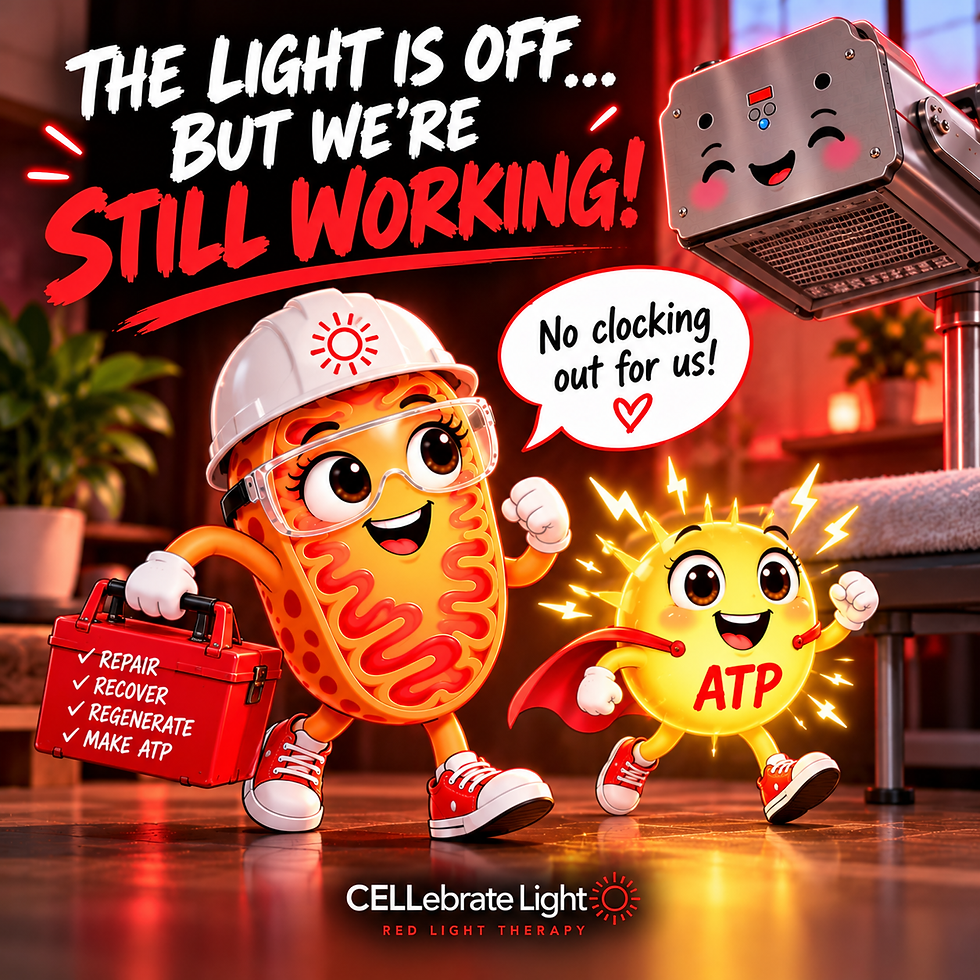
Remember Our Little Mitochondria? ⚡
You know, those hardworking little powerhouses inside our cells?
The ones we've been talking about for the last couple of weeks?
Well, they're back. 😂
Mitochondria help produce ATP, the energy our cells use to carry out countless functions.
Researchers studying photobiomodulation (PBM) are investigating how specific wavelengths of red and near-infrared light interact with our tissues and influence cellular processes, including mitochondrial activity and cellular signaling.
Pretty fascinating stuff!
But here's where it gets interesting.
Light isn't just about brightness. It's also about how much reaches the tissue and for how long.
Meet the Goldilocks Principle 🐻
Remember Goldilocks?
One bowl of porridge was too hot. Another was too cold. And one was just right.
Well, red light therapy has something similar.
Scientists have observed what's called a biphasic dose response in some photobiomodulation research.
In simple terms, that means a lower dose of light may produce a beneficial biological response, while increasing the dose doesn't necessarily improve that response—and in some situations may reduce it.
Does that mean there's one magical dose that works for everyone?
Nope!
The appropriate parameters depend on the treatment goal, tissue, device and other factors.
The takeaway? More light doesn't guarantee more benefit.
Apparently, even our mitochondria appreciate a little moderation. 😂
So What Actually Matters?
Last week, we introduced what we call the BIG 4 at CELLebrate Light:
POWER • WAVELENGTH • INTENSITY • BODY COVERAGE
Now let's add another important piece to that conversation.
DOSE.
Think of it this way.
Wavelength: What kind of light are we delivering?
Intensity: How much light is reaching the treatment area?
Treatment time: How long is the exposure?
Distance: How far is the device from the body?
Coverage: How much of the body are we treating?
Together, these factors help determine how light is delivered.
And here's something worth remembering:
Twenty minutes with one device is not necessarily equivalent to twenty minutes with another.
Different devices can deliver very different amounts and distributions of light.
That's why simply asking, "How long should I sit under a red light?" doesn't always have a straightforward answer.
And What About All Those Different Devices?
Masks. Panels. Handheld devices. Full-body systems.
They're everywhere!
And while they may all use some form of red or near-infrared light, their specifications and intended applications can differ considerably.
At CELLebrate Light, our RX Series uses plasma arc lamp technology rather than conventional LED panels.
But regardless of the light source, understanding wavelength, intensity, exposure and appropriate dosing is important.
Because the goal isn't simply to create a beautiful red glow.
The goal is to understand the light we're delivering and the biological response we're hoping to support.
Here's What I Love About the Science ❤️
The more I learn about the human body, the more amazed I become.
Our bodies are constantly working, adapting, repairing and responding to the world around us.
And while red light therapy is an exciting area of research, it's important to remember that it isn't a magic wand.
Good nutrition matters.
Sleep matters.
Movement matters.
Recovery matters.
And when we're dealing with injuries or medical conditions, appropriate medical care matters.
Red light therapy may be a supportive tool in certain situations, but the evidence varies by application and researchers are still learning which treatment parameters work best.
Which brings me back to something I keep saying:
Red light is a tool. Your body is the miracle.
And maybe that's what makes this science so fascinating.
We're not trying to replace what the body does naturally.
We're exploring ways to support its remarkable biological processes.
One Last Thought…
Next time someone tells you that the strongest, brightest or longest red light treatment must be the best, remember our little mitochondria.
I can almost hear them saying:
"Whoa, whoa, whoa…let's talk about the dose first!" 😂🔴
Because when it comes to photobiomodulation…
It's not about MORE light. It's about understanding the RIGHT light.
And that, my friends, is worth shining a little attention on.
❤️ Let's Light It Up!
— Adonica


Comments