


The Light Goes Off… But Are Your Cells Still Working? 🔴⚡

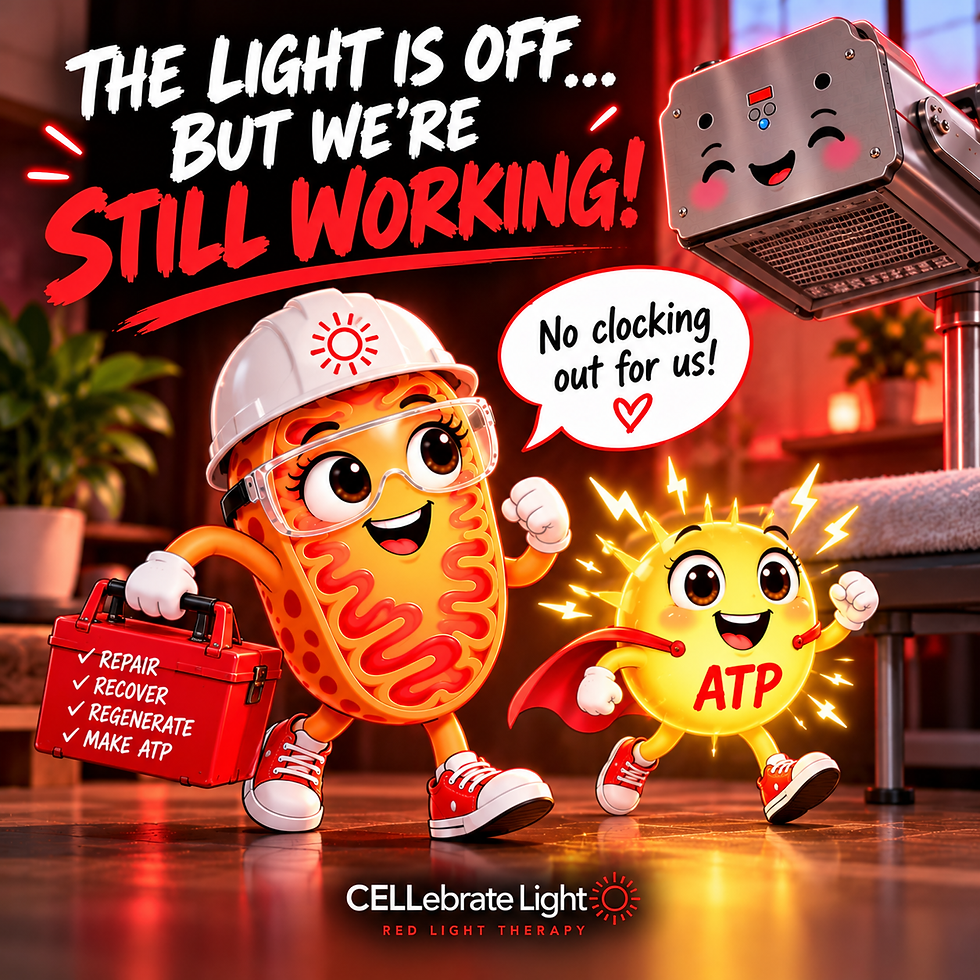
What happens after a red light therapy session—and why the science is more interesting than simply watching the clock.
Okay, friends. I have a question.
When you finish a red light therapy session and the machine turns off, what happens next?
Does your body simply say, "Well, that was lovely. Back to business as usual!" 😂
Does your mitochondria clock out, grab its lunch bag, and head home?
Not exactly!
And this is where the science behind photobiomodulation gets really interesting.
Because red light therapy isn't just about what happens while the light is shining.
It's also about the biological responses that light may help initiate.
Let's break it down without needing a science degree!
First, Remember Our Little Mitochondria? ⚡
Our hardworking little cellular powerhouses have been getting quite a bit of attention lately.
And for good reason!
Mitochondria help produce ATP, the energy our cells use to perform essential functions.
But they're involved in much more than energy production.
They also participate in cellular communication, metabolism, and responses to stress.
Think of them as tiny power stations that are also part of the body's communication network.
Busy little things, aren't they? 😂
Now here's where red light therapy enters the conversation.
Researchers studying photobiomodulation (PBM) are investigating how certain wavelengths of red and near-infrared light interact with biological tissues.
One proposed mechanism involves an enzyme in mitochondria called cytochrome c oxidase.
Don't worry. There won't be a spelling test. 😂
The important part is that light may influence cellular activity and signaling pathways.
And those biological responses don't necessarily end the instant the light switches off.
Wait… The Light Can Start a Conversation?
In a way, yes!
Think about exercise for a moment.
When you finish a workout, your body doesn't immediately stop responding.
Your heart rate gradually settles. Your body begins replenishing energy stores. Adaptation and recovery processes continue.
Now, red light therapy is NOT the same as exercise.
But the comparison helps explain an important concept.
A stimulus can be brief while the biological response continues afterward.
In PBM research, scientists are studying how light exposure may influence processes involving mitochondrial activity, nitric oxide, reactive oxygen species, and cellular signaling.
Some of those changes may continue after exposure ends.
The exact response depends on the tissue, treatment parameters, and biological circumstances.
In other words…
The light doesn't have to stay on forever for scientists to be interested in what happens next.
Pretty fascinating, right?
Your Body Is Still the Star of the Show ❤️
Here's something I really want people to understand.
Red light therapy doesn't do the body's work for it.
Your body already has remarkable systems involved in maintaining tissues, responding to stress, and supporting recovery.
Researchers are exploring whether appropriately delivered light can influence some of those processes.
But that doesn't mean every session produces a noticeable benefit—or that red light therapy can treat every condition.
The evidence is stronger for some applications than others, and researchers are still working to understand optimal treatment protocols.
Which brings me back to something I say all the time:
Red light is a tool. Your body is the miracle.
And I genuinely believe that's one of the most important messages we can share.
But Don't Forget the Basics!
Here's where I'm going to put my fitness hat on for a minute. 😂
We can talk about mitochondria, ATP, cellular signaling, and fancy technology all day long.
But none of that replaces the foundations of taking care of ourselves.
Sleep matters.
Your body needs adequate rest to support normal recovery and everyday functioning.
Nutrition matters.
Our cells need nutrients to produce energy, maintain tissues, and carry out essential processes.
Movement matters.
Appropriate physical activity helps support strength, cardiovascular health, mobility, and healthy aging.
Recovery matters.
Sometimes the most productive thing we can do is allow our bodies time to rest.
And when we're recovering from an injury, surgery, or medical condition, professional healthcare and rehabilitation remain essential.
Red light therapy may have a role as a complementary tool in certain circumstances.
But it isn't a substitute for the fundamentals.
And it certainly isn't a magic wand.
Although wouldn't that make life interesting? 😂
So Why Does the Dose Matter So Much?
Remember last week's conversation?
More red light doesn't automatically mean better results.
And twenty minutes with one device isn't necessarily equivalent to twenty minutes with another.
That's because wavelength, irradiance, distance, treatment area, and exposure time influence the light dose delivered.
These parameters may affect the biological response.
And here's an important distinction:
A longer session doesn't guarantee a stronger or longer-lasting benefit.
The relationship between light exposure and biological response can be complex.
Researchers have observed biphasic dose responses in some PBM studies, meaning increasing the dose beyond a certain range may not improve the response.
So our little mitochondria are still very much in their Goldilocks era. 😂
Not simply MORE.
Not simply LONGER.
The appropriate parameters for the intended application.
Let's Talk About Healthy Aging
This is the part that really interests me.
As someone who has spent decades in the fitness and wellness industry, I've always been fascinated by what our bodies are capable of.
And the older I get, the more interested I become in supporting health, function, and quality of life.
Not because I want to turn back the clock.
But because I want to enjoy the years ahead!
Healthy aging isn't about pretending we're 25 again.
It's about continuing to move, learn, challenge ourselves, recover, and live well.
Our mitochondria play important roles in cellular function throughout life, and scientists are investigating how mitochondrial health relates to aging.
PBM is one of many research areas exploring how light may influence cellular processes.
That doesn't mean red light therapy has been proven to slow human aging.
But it does make the science worth understanding.
And I think that's exciting!
One Last Thought… 🔴
The next time you finish a red light therapy session, remember this:
The light has stopped shining.
But the biology we're studying is much more complicated than an on-and-off switch.
Your body is constantly responding, adapting, and carrying out countless processes behind the scenes.
And while researchers continue exploring what photobiomodulation can—and cannot—do, there's one thing we already know.
Our bodies are pretty incredible.
Even when we're not paying attention.
And somewhere in there, our little mitochondria are probably saying…
"Excuse me! We're STILL working here!" 😂⚡
So give your body the basics it needs.
Feed it well.
Move it.
Let it rest.
Take care of it.
And keep learning about the remarkable science of light.
Because…
Red light is a tool. Your body is the miracle. ❤️
🔥 Let's Light It Up!
— Adonica
Educational note: Photobiomodulation is an active area of research. Biological effects, clinical benefits, and appropriate treatment parameters vary by application. Red light therapy should not replace medical treatment, rehabilitation, or advice from a qualified healthcare professional.


Comments